
Process
Choosing the optimal manufacturing process—for example, injection molding for high-volume parts or machining for prototyping—ensures cost-efficiency and consistency.

Design for Manufacturability (DFM) — also known as Design for Manufacturing — is a strategic engineering methodology that emphasizes developing a design to facilitate efficient, cost-effective, and high-quality manufacturing. Fundamentally, DFM enables designers and engineers to identify and resolve potential production challenges during the design phase, which is the most economical stage to address such issues.
Importantly, empirical data suggest that over 70% of a product’s total manufacturing cost (including materials, processing, and assembly) is determined by early design decisions. Thus, adopting DFM early in the design process can significantly improve product development outcomes and reduce manufacturing cost burden.
Choosing the optimal manufacturing process—for example, injection molding for high-volume parts or machining for prototyping—ensures cost-efficiency and consistency.

Simplifying the design reduces complexity, minimizes part count, and leads to streamlined assembly processes, thereby decreasing manufacturing errors

Selection of appropriate materials directly influences cost, manufacturability, performance, and durability. Material choices must balance functionality with availability and cost-effectiveness.

Products must be tailored to environmental conditions they will encounter—thermal stresses, chemical exposure, mechanical loads—to maintain functionality and longevity.
Designs should conform to applicable safety and quality standards (e.g., ISO, UL, ETL) and be amenable to third-party testing without extensive redesign.
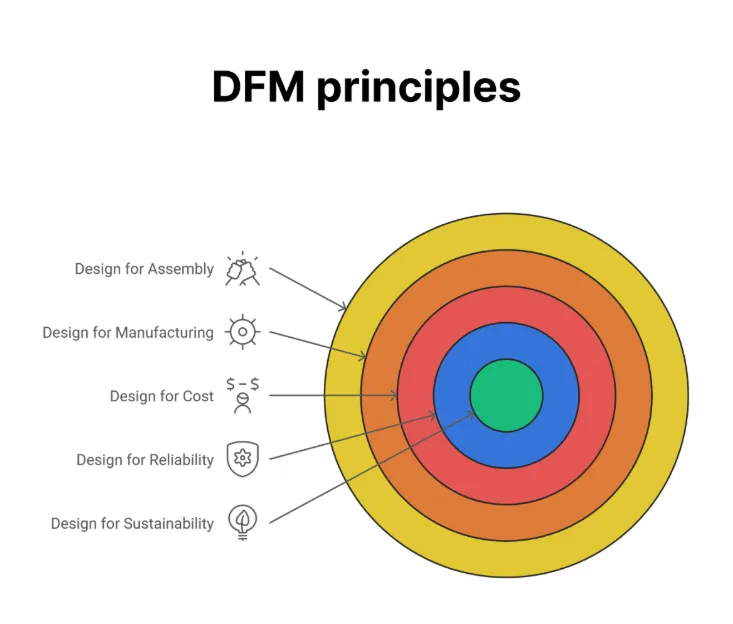
Reducing the number of parts not only lowers material and labor costs but also simplifies supply chains and assembly workflows.
Using standardized parts reduces lead times, ensures consistency, and simplifies inventory management.
Modular design empowers scalable fabrication and simplifies future upgrades or customization.
Maximizing the use of clips, interlocks, and snap-fits instead of screws or adhesives speeds assembly and reduces components.
Design parts to reduce handling and reorientation, thereby cutting time and reducing errors.
Avoid unnecessary or complex operations that elevate cost and introduce variability.
Choose functional surface finishes over cosmetic ones unless specifically required for marketing or regulatory reasons.
High production costs
Minimize Part Count; Modular Design
Reduces material use, manufacturing complexity, and cost per part
Assembly bottlenecks
Design for Efficient Joining; Modular Design
Speeds assembly and lowers error risk
Quality and reliability issues
Design; Material; Compliance/Test
Ensures consistency, compliance, and durability
Lengthy time-to-market
Streamline Processes; Modular Design
Speeds development and assembly cycles
Tight tolerances inflating cost
Define Acceptable Surface Finishes; Process selection
Avoids unnecessary precision that increases production expense
Environmental or lifecycle complexity
Material; Environment; Compliance/Test
Ensures product resilience and regulatory readiness
Ensuring proper ejection paths avoids part damage and cycle delays
Undercuts demand side-actions or slide tools, increasing complexity and cost.
Uneven wall thickness can lead to warping or sink marks.
Draft angles streamline mold release, reducing cycle time and improving quality.
While precision is often desirable, overly tight tolerances can dramatically increase manufacturing cost. This is because achieving very narrow tolerances often requires specialized tools, slower machining feed rates, and elevated inspection routines—ultimately inflating cost without meaningful benefit. Good DFM practice specifies only as tight as necessary tolerances to preserve function while controlling cost
The duration of a full DFM process depends on design complexity, team size, iteration needs, and tools available:
By integrating DFM early—and deeply—into your product development life cycle, Source Engineering Services can ensure: